 Save
Save I'll never forget the first time I arranged food in that flowing figure-eight pattern at a dinner party. It was supposed to be elegant, but honestly, I was nervous—would it actually taste as beautiful as it looked? That night, watching guests lean in closer to admire the infinity loop before taking their first bites, I realized that food isn't just about flavor; it's about the moment you create together. This dish changed how I think about plating, about turning a simple meal into something that feels like art on the plate.
I made this for my sister's book club last spring, and I still remember how she stood in the kitchen doorway watching me arrange those delicate vegetable ribbons. She laughed and said it looked too pretty to eat, which is exactly when I knew the recipe had worked. We ended up taking so many photos before anyone touched their plates that the couscous cooled slightly, but nobody minded—they were already charmed.
Ingredients
- Fresh salmon fillets (300 g total, skinless): The star of this dish—I learned to ask the fishmonger to remove the skin for you, which saves time and ensures perfectly flaky results. Choose fillets that are firm to the touch and smell briny, never fishy.
- Olive oil (1 tbsp): Use good quality oil here; it's one of the few ingredients you taste directly on the salmon. I prefer something fruity, not too peppery.
- Salt and freshly ground black pepper: Always grind your pepper fresh—pre-ground loses its brightness and becomes almost dusty.
- Medium zucchini (1, thinly sliced): A mandoline makes quick work of this, but a sharp knife works too. Slice thin enough to see light through it—this is where thinness becomes elegance.
- Medium carrot (1, thinly sliced): The natural sweetness of carrots bridges the gap between the earthy couscous and the delicate fish beautifully.
- Small fennel bulb (1, thinly sliced): This is the secret ingredient that makes people pause and ask what that subtle licorice note is. Don't skip it, even if fennel seems unfamiliar—it's transformative here.
- Baby spinach leaves (1 cup): Raw spinach adds a fresh, peppery contrast. If you can't find baby spinach, chop regular spinach into small pieces.
- Pearl couscous (1/2 cup): Pearl couscous has more texture than regular couscous, which matters when you're building something meant to be admired. It holds its shape better and catches light beautifully on the plate.
- Vegetable broth (1 cup): Homemade is best, but good quality store-bought works. Avoid anything with added salt; you'll season to taste at the end.
- Greek yogurt (2 tbsp): Full-fat yields a richer dressing; choose a plain variety so you control all the flavors.
- Lemon zest (1 tsp): Use a microplane—it creates delicate shreds that distribute flavor more evenly than a box grater. Zest the lemon before cutting it in half.
- Fresh dill (1 tbsp, finely chopped): Fresh dill is essential; dried dill tastes like straw by comparison. Chop it just before assembling so it stays bright green and aromatic.
- Capers (1 tbsp, rinsed and drained): The briny burst of capers against creamy yogurt is one of those combinations that just works. Rinsing removes excess salt—always do this.
- Toasted pine nuts (1 tbsp): Toast them yourself in a dry pan for 2-3 minutes if possible. Store-bought toasted nuts lose their fragrance quickly, but fresh-toasted pine nuts are sublime.
Tired of Takeout? 🥡
Get 10 meals you can make faster than delivery arrives. Seriously.
One email. No spam. Unsubscribe anytime.
Instructions
- Setting the stage:
- Preheat your oven to 180°C (350°F). While it's heating, gather all your ingredients and arrange them on your workspace. This is where cooking becomes easier—having everything ready means you're not scrambling while something's cooking.
- Coaxing the couscous:
- In a small saucepan, bring the vegetable broth to a full, rolling boil—you'll hear it before you see it. Pour in the pearl couscous and immediately reduce the heat to low. Cover tightly with a lid and let it steam for 10 minutes undisturbed. When the time's up, remove from heat and let it sit, covered, for another minute. Fluff gently with a fork, breaking up any clumps. The grains should be tender but still have a subtle bite to them.
- Embracing the vegetables:
- Fill a large pot with salted water and bring it to a boil. Working quickly, blanch your zucchini, carrot, and fennel slices separately for just 1 to 2 minutes each—you're looking for tender but not soft, still with a slight snap. As each vegetable finishes, transfer it immediately to a bowl of ice water to stop the cooking and lock in that bright color. Pat everything dry with paper towels; excess moisture will prevent your figure-eight from looking pristine.
- Honoring the salmon:
- Pat your salmon fillets dry with a paper towel, then rub them gently with olive oil. Season simply with salt and pepper—let the fish taste like itself. Place them on a parchment-lined baking tray and slide into your preheated oven. Bake for 12 to 15 minutes, depending on thickness; the salmon is done when it flakes easily with a fork and has lost its translucent quality but still looks moist. Remove and let it cool for just a few minutes so it's still warm but easy to handle. Break it gently into large, neat flakes—you want pieces that feel substantial.
- Crafting the dressing:
- In a small bowl, stir together the Greek yogurt, lemon zest, and fresh dill until smooth and vibrant green flecks are visible throughout. Taste it and add a pinch of salt if needed. This dressing is your finishing touch, so make sure it's balanced and bright.
- Painting the infinity loop:
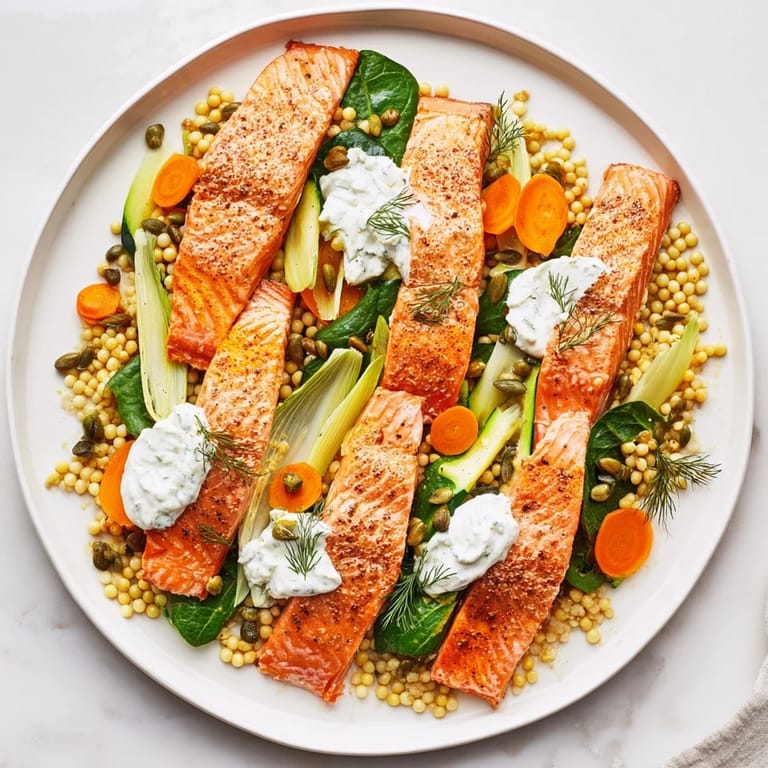
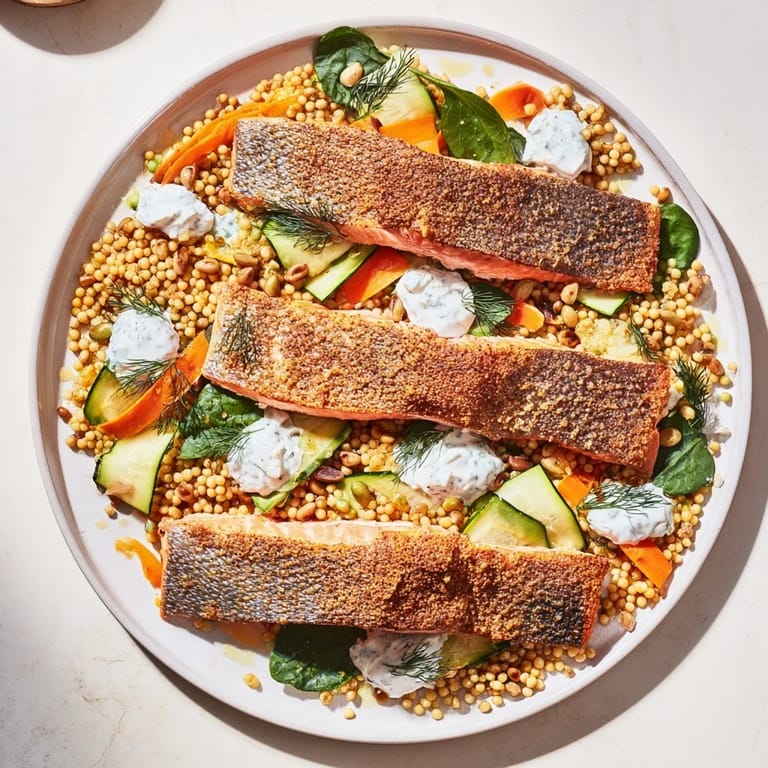
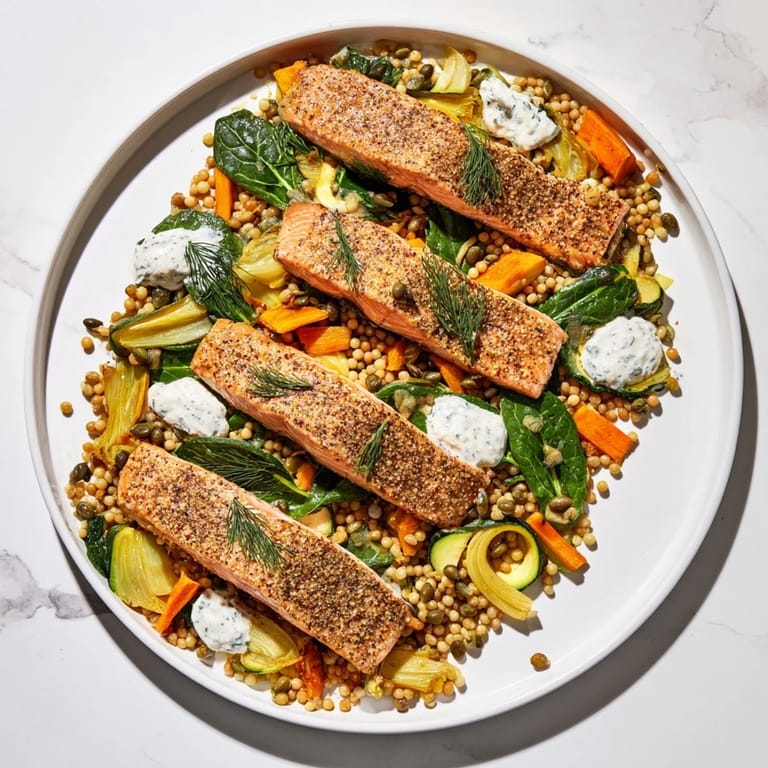
- This is where it all comes together. On your largest, most beautiful platter, spoon the pearl couscous in a smooth, flowing figure-eight shape, using the back of your spoon to create gentle curves. Think of it like drawing with food—there's no rigid right way, just flowing and organic. Now, arrange your blanched vegetables along the loop in alternating colors: zucchini, carrot, fennel, spinach, repeating as you go around. Nestle the salmon flakes into the curves where you can, so they rest naturally against the couscous. Dot the yogurt dressing around the loop in small spoonfuls—think constellations, not coverage. Finally, scatter the toasted pine nuts over the top for texture and visual interest.
- The moment of sharing:
- Serve immediately while everything is still at its perfect temperature. As you plate for guests, make sure each portion captures that seamless flow, that sense of flavors and textures traveling in one continuous direction.
 Save
Save I'll always remember my grandmother's words when she watched me fuss over the plating: 'Food should nourish the eyes before it nourishes the belly.' That's exactly what this dish does. It transformed the way I think about everyday cooking.
Why This Plating Technique Matters
The infinity loop isn't just visually clever—it serves a real purpose. When you eat in that flowing pattern, you're naturally guided through a progression of flavors. You might start with couscous and spinach, move through vegetables, encounter salmon, and finish with the bright yogurt dressing. It's like the dish is telling a story as you eat, each component building on the last. I've noticed that when people eat from a plate arranged this way, they slow down. They become more intentional about each bite. Food arranged with thought tastes better, somehow.
Variations That Keep This Fresh
Once you master this technique, you'll start seeing infinite variations. Try thin slices of radish for a peppery bite, or roasted beets for earthiness and deeper color. In spring, I use asparagus instead of some of the vegetables. Trout or cod work beautifully if you prefer something milder than salmon. Even the grain can change—farro, quinoa, or wild rice all work if you adjust cooking times. The magic isn't in specific ingredients; it's in the principle of flowing, layered arrangement.
Creating Moments Worth Remembering
Here's what I've learned about cooking recipes like this: they're not really about the food, not entirely. They're about the moment you create when you put something beautiful in front of the people you care about. That pause before the first bite, when they're taking in the colors and shapes, when the kitchen smells like fresh dill and lemon—that's the real recipe.
- Always serve this on your nicest platter, even if it's just for yourself. You deserve that kind of intentionality.
- Pair it with a crisp Sauvignon Blanc or a light-bodied Pinot Gris to echo the delicate, fresh flavors on the plate.
- Make extra dressing—people always want more of that creamy, tangy yogurt component, and you'll want it for the inevitable second helpings.
 Save
Save This dish has a way of becoming a favorite not because it's complicated, but because it reminds us why we cook in the first place. Make it once, and I promise you'll make it again.
Recipe FAQs
- → What type of fish is best for this dish?
Fresh skinless salmon fillets provide the ideal texture and flavor, though trout or cod can be suitable alternatives.
- → How should the vegetables be prepared?
Thinly slice zucchini, carrot, and fennel, then blanch briefly in boiling salted water to preserve color and tenderness.
- → What is the purpose of the figure-eight arrangement?
The continuous loop shape creates a visually striking presentation and allows for an elegant progression of flavors with each bite.
- → How do I prepare the pearl couscous?
Simmer pearl couscous in vegetable broth for about 10 minutes until tender, then fluff with a fork before shaping.
- → What garnishes complement the dish?
Capers, a dill and lemon zest yogurt dressing, and toasted pine nuts add brightness, creaminess, and crunch.